
|
|
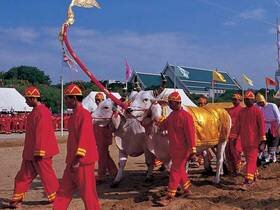
The Royal Ploughing Ceremony was probably, in the old times, the rite designed to remind the farmers and to give an auspicious beginning to the new planting season especially the rice farming that is the major source of food. The leader or the rulers of the country preside over the ceremony when the planting seasons begin. to remind the farmers and to give an auspicious beginning to the new planting season especially the rice farming that is the major source of food. The leader or the rulers of the country preside over the ceremony when the planting seasons begin. After some times passed, the Brahmanic rite called Ploughing ceremony was then introduced. Its purpose is to encourage the power and happiness. Bhraman were instructors for the ceremony. The king or the leader of the country may designate this duty to a respective high-ranking officer to perform the ceremony as Phraya Raekna, Lord of the Ploughing Ceremony. The roles of the queen or wives who had to help ploughing are designated to four celestial maidens, called the queen of sowing ceremony, assisting Phraya Raekna by carrying seeds containers and distribute the seeds after Phraya Raekna had ploughed the ground. The Royal Ploughing Ceremony has been annually performed for thousands of years in several countries such as China and India. In Thailand, this ceremony has been performed since Sukhothai was the capital. It had been continued in Ayuthaya and Ratanakhosindhu (Bangkok) period. The Royal Ploughing ceremony performed during the reign of King Rama I, II, and III was purely the Bhramanic rite as it had been in Ayutthaya period i.e. there was no Buddhist monk participated in the ceremony. In the reign of King Rama IV, the King had royal command to initiate the Buddhist rite together with the original ceremony. The reason was to prosper all the cereals brought into the ceremonial field. After the Buddhist rite that is performed in the first day, the Bhramanic ceremony The combined rite was so called the Royal Ploughing ceremony that lasts for 2 days. The day for Royal Ploghing Ceremony therefore cannot be set in a certain date. However, it is normally in May. The reason that it is required to be in the sixth month is that it is the beginning of raining season. This time is a good time for farmers to start working on their farm, which is an important work of Thai society for a very long time. After the royal astrologer had already calculated and got the auspicious day for the Royal Ploughing Ceremony, The Bureau of the Royal Households would mark the calculated date into the royal calendar that the king annually gives to his people. The calendar clearly states the date for both rites of the ceremony. The Royal Ploughing ceremony day is announced by the cabinet as a Public holiday but the national flag is raised as it is in usual working days. The Royal Ploughing Ceremony is very important and it is a prosperous ceremony to encourage all the farmers.
|
||||||||||||||